The History of Foreign Exchange Payments

Rotem Magen
Head of EMEA Sales, Covercy · April 25, 2025
International money transfers are something we take for granted today. With a few taps on your phone, you can send funds across the globe in minutes. But this convenience is the result of thousands of years of financial evolution.
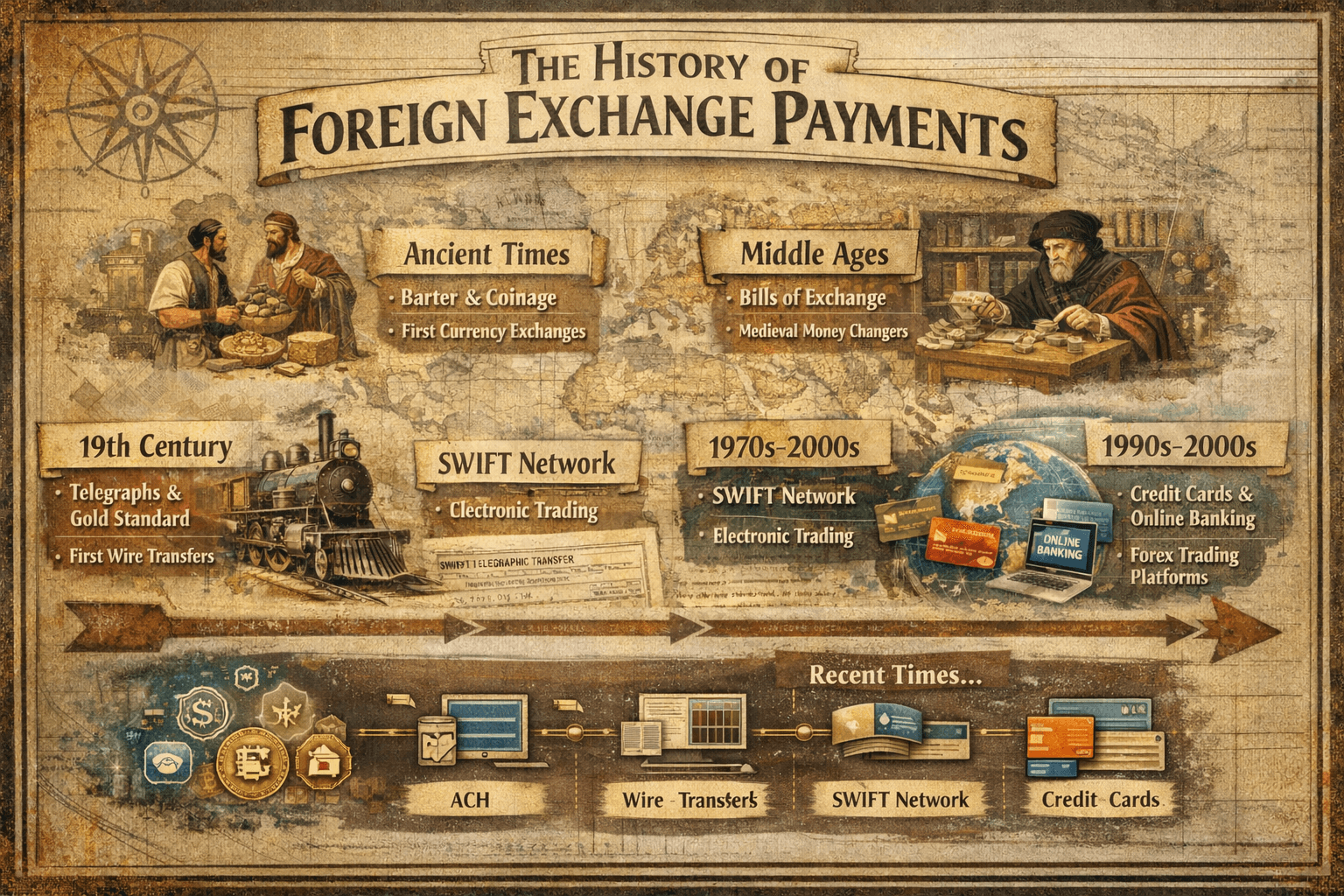
The story of foreign exchange begins in ancient times. Before money existed, people relied on barter—trading goods directly for other goods. A farmer might exchange wheat for pottery, but this system had obvious limitations. What if the potter didn't need wheat?
The invention of money solved this problem. Ancient civilizations like the Mesopotamians, Greeks, and Romans developed coins made from precious metals. These coins had intrinsic value and could be exchanged for any goods or services. However, international trade still posed challenges—different regions used different currencies.
The first true foreign exchange transactions emerged in the ancient Mediterranean. Money changers would sit at benches (the origin of the word 'bank' from the Italian 'banco') and exchange coins from different regions, charging a fee for their service.
During the Middle Ages, the Knights Templar pioneered an early form of international money transfer. Pilgrims traveling to the Holy Land could deposit funds with the Templars in Europe and withdraw equivalent value in Jerusalem, avoiding the dangers of carrying gold across hostile territories.
The Renaissance brought the rise of powerful banking families like the Medicis in Florence. They established branches across Europe and developed sophisticated systems for transferring funds between cities using letters of credit—essentially written promises to pay.
The 19th century saw revolutionary changes. The gold standard linked currencies to gold reserves, making exchange rates more predictable. The telegraph enabled near-instantaneous communication across continents, and the first international wire transfers became possible.
In 1973, SWIFT (Society for Worldwide Interbank Financial Telecommunication) was founded, creating a standardized messaging system for international bank transfers. This network, still in use today, enabled banks worldwide to communicate securely and efficiently about cross-border payments.
The late 20th and early 21st centuries brought the digital revolution. Online banking made international transfers accessible to individuals, not just businesses. However, traditional bank transfers remained slow and expensive, with multiple intermediary banks each taking a cut.
Today, fintech companies like Covercy are transforming international payments. By leveraging technology and building direct relationships with local payment networks, we can offer faster, cheaper, and more transparent transfers than traditional banks.
The journey from ancient money changers to modern digital payments spans millennia, but the core need remains the same: moving value safely and efficiently across borders. At Covercy, we're proud to be part of this ongoing evolution, making international payments accessible to everyone.
Ready to experience modern international transfers? Create your free account and see why over 60,000 customers trust Covercy for their global payment needs.